
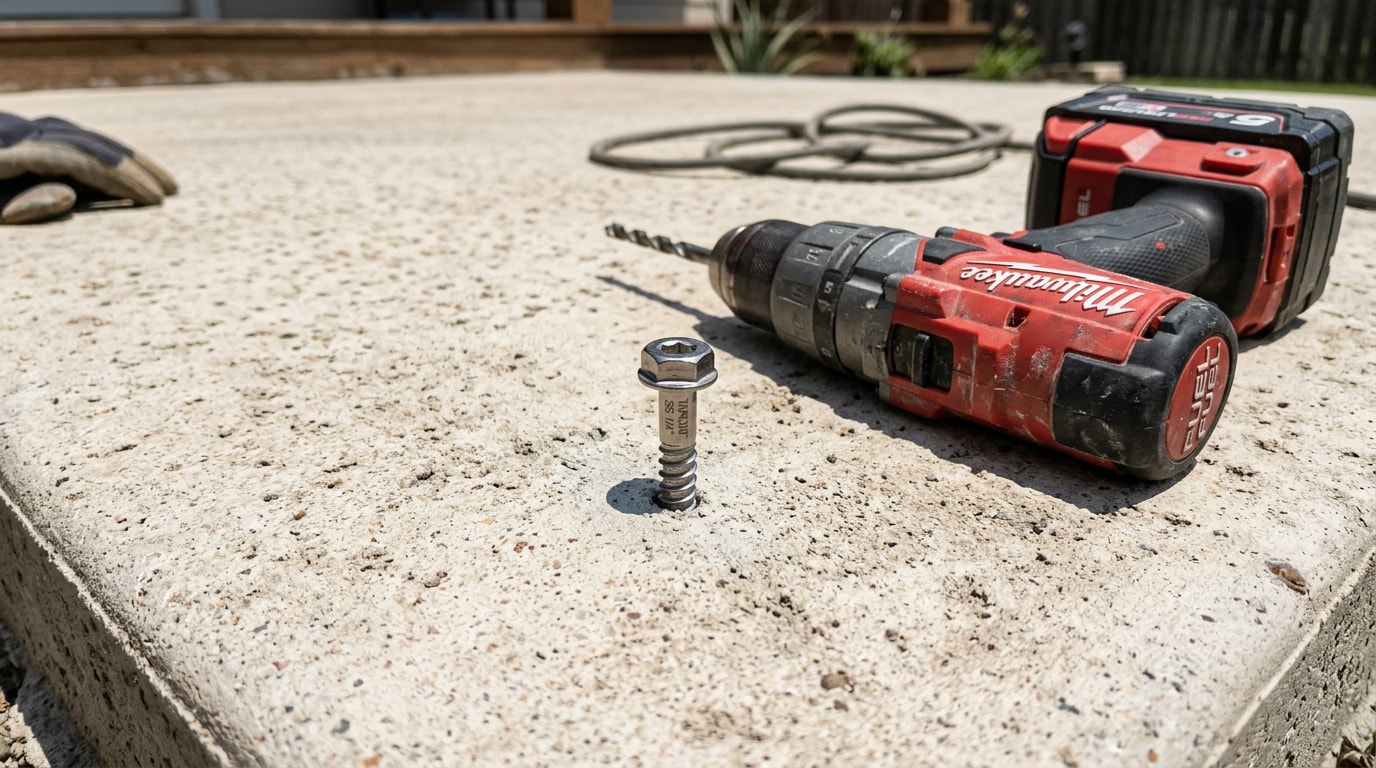
Concrete screws in Waxahachie, TX are the fastest way to anchor hardware, ledger boards, or fixtures into a cured slab, brick wall, or block foundation without renting equipment. Buy the wrong diameter, head style, or finish, though, and you'll either strip the hole or watch rust streak down a patio wall within a year. This guide covers exactly what to buy, which tools you need, and how to install concrete screws correctly the first time.
What Are Concrete Screws (Tapcon) and Why Choose Them?
A concrete screw, often called by the popular brand name Tapcon, is a self-tapping masonry fastener that cuts its own threads into concrete, brick, or block as it's driven. Unlike expansion anchors, it doesn't rely on compressing the base material to hold. The hardened threads bite into the masonry itself.
That means a smaller pilot hole and a fastener you can usually back out and reinstall later. It's a big part of why concrete screws are the default choice for lighter and mid-duty jobs over wedge, sleeve, or epoxy anchors. We compare those options directly below.
Our crews at Hi-Tek Paving install ledger boards, bollard sleeves, and signage anchors into freshly placed slabs across Ellis County every month. The single most common callback we see isn't a bad screw. It's a shelf or handrail that worked loose within a year, almost always traced back to a stripped hole or the wrong fastener for the job.
Concrete Screws vs. Wedge, Sleeve, and Epoxy Anchors
Concrete screws aren't the right fastener for every masonry job. Here's how they stack up against the other common anchor types contractors reach for in the Waxahachie area.
| Anchor Type | Best For | Typical Embedment | Removable? | Approx. Safe Working Load |
|---|---|---|---|---|
| Concrete Screw (Tapcon-style) | Light-to-medium loads, brick/block/concrete, hardware you may remove later | 1" – 1-3/4" | Yes | ~150–750 lbs |
| Sleeve Anchor | Medium loads in solid or hollow masonry | 1-1/2" – 2-1/2" | No | ~200–800 lbs |
| Wedge Anchor | Heavy structural loads, solid uncracked concrete only | 2-1/2" – 4" | No | ~750–2,000+ lbs |
| Epoxy/Adhesive Anchor | Structural connections near edges or in cracked concrete | Varies by rod diameter | No | Highest; engineer-specified |
These are general reference ranges, not a substitute for a manufacturer's load table. If a connection carries real structural weight, like a deck ledger or a mounted piece of equipment, size it against the specific anchor's ICC-ES evaluation report rather than a rule of thumb.
Head Styles, Diameter & Materials: Choosing the Right Concrete Screw
Picking the right concrete screw comes down to matching the fastener to the job, not grabbing whatever's cheapest on the shelf. Three variables drive that decision: head style, diameter, and material finish.
Head Styles & Configurations
Concrete screws come in three common head styles: hex washer, flat countersunk, and six-lobe.
- Hex washer heads use a slotted design driven with a nut driver. They work well for utility brackets, conduit straps, and anywhere a visible head doesn't matter.
- Flat countersunk heads, driven with a Phillips bit, sit flush with the surface. They're the right pick for door thresholds, trim, or anywhere a protruding head would get in the way.
- Six-lobe heads show up more in commercial and high-torque applications where stripping the drive is a real risk.
Whichever style you choose, make sure you've got the matching driver bit on hand before you start. Hex and Phillips drivers aren't interchangeable.
Concrete Screw Diameter & Hole Size
Concrete screws commonly come in two standard diameters, 3/16 inch and 1/4 inch, with heavier-duty projects stepping up to 3/8, 1/2, 5/8, or 3/4 inch. Each diameter requires an exact matching carbide drill bit size. The tolerance between hole and screw is tight enough that the wrong bit will either strip the hole or prevent the screw from threading at all.
Here's a quick reference for the most common sizes:
| Screw Diameter | Carbide Bit Size | Minimum Embedment |
|---|---|---|
| 3/16" | 5/32" | 1 inch |
| 1/4" | 3/16" | 1 inch |
| 3/8" | 5/16" | 1 1/2 inches |
Always check the manufacturer's packaging for your specific product line. Embedment minimums and bit sizing are spelled out in the fastener's ICC-ES evaluation report, and they can vary slightly by brand and base-material strength.
Concrete Screw Materials & Finishes
Concrete screws are made in three main finishes: zinc-plated carbon steel, hot-dip galvanized, and stainless steel.
Zinc-plated is fine for indoor, dry applications, but it corrodes quickly outdoors. Galvanized and stainless steel concrete screws, including 410, 304, and 316 grades, hold up far better where moisture is a factor.
In the Waxahachie and broader DFW area, that distinction matters more than it might seem. Humid summers, sudden freeze-thaw swings, and plenty of outdoor decks, patio covers, and HVAC condenser pads mean exterior fasteners see real moisture exposure most of the year.
For those applications, stainless steel concrete screws are worth the extra cost. The corrosion-resistance mechanics behind these finish choices are explained in detail by the American Galvanizers Association.
Essential Tools and Materials for Installation
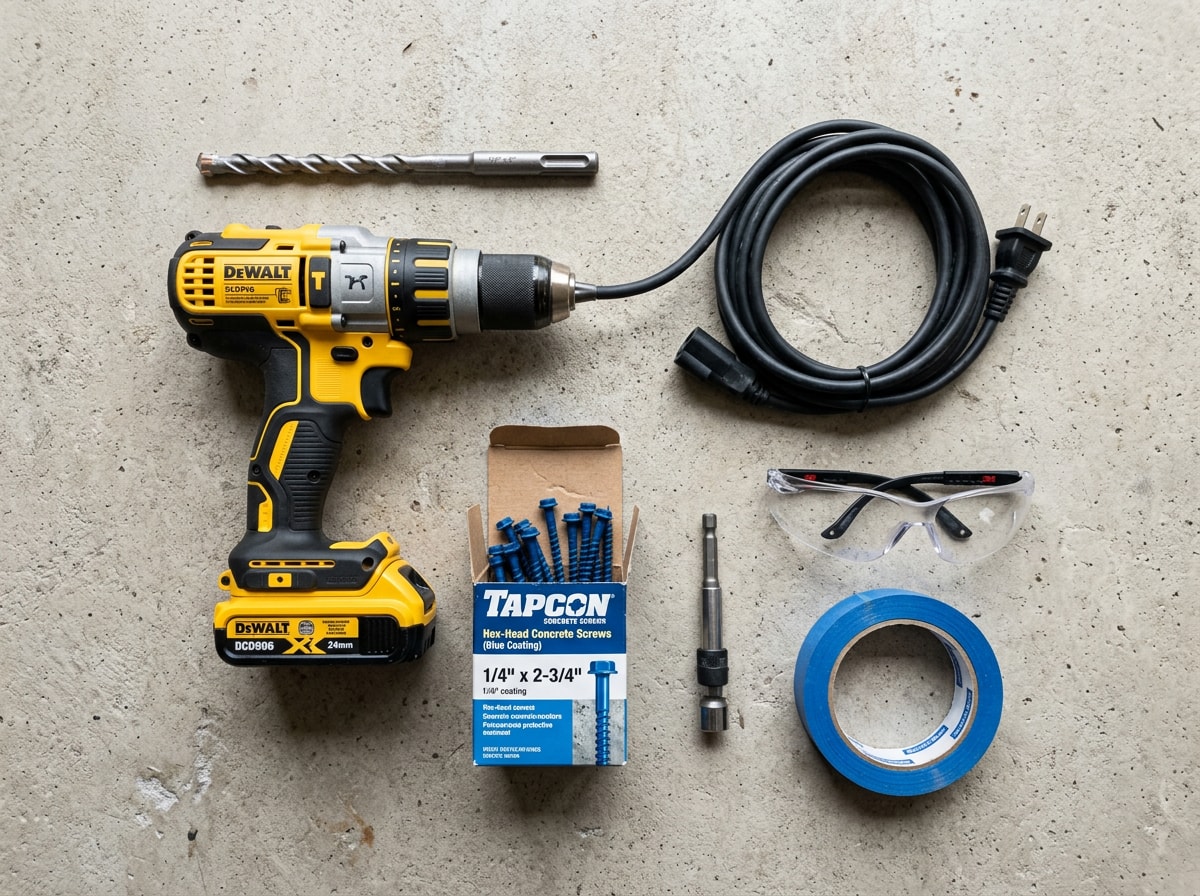
Before driving a single screw, gather:
- A carbide-tipped masonry drill bit sized to your screw
- A hammer drill
- Painter's tape for marking depth
- The correct driver bit for your head style
- Basic safety gear
A standard drill will burn out quickly trying to bore into concrete. A hammer drill's percussive action is what actually breaks up the masonry as the bit cuts.
Safety glasses are non-negotiable here, since drilling masonry throws off fine dust and occasional chips. Keep a shop vacuum or wire brush nearby too. You'll need it for the cleaning step coming up next.
Step-by-Step Installation Guide: Getting It Right the First Time
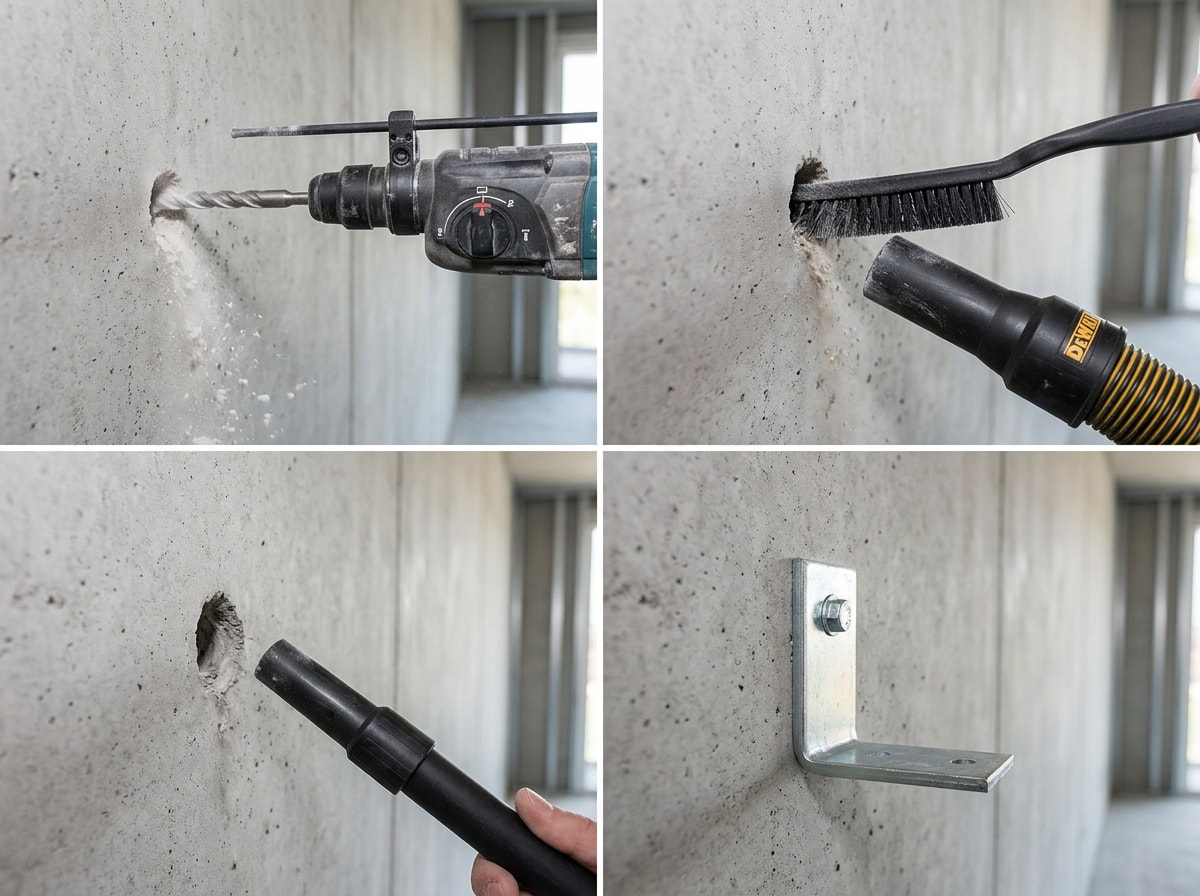
Four steps cover nearly every concrete screw installation, but the devil is in two of them: drilling and cleaning.
- Drill the pilot hole. Use a hammer drill with the correctly sized carbide bit, and drill at least 1/2 inch deeper than the screw's embedment depth. A shallow hole is the single biggest reason screws bottom out before seating. Mark your bit with painter's tape at the target depth so you don't eyeball it.
- Clean the hole completely. Use a wire brush, compressed air, or a vacuum to remove all drilling dust. Skipping this step is the other major failure point. Leftover dust acts like a lubricant, which drastically reduces thread holding power even when the hole looks fine.
- Insert the screw through the fixture and into the cleaned hole.
- Drive the screw slowly until the head sits tight against the fixture. Don't over-torque. Pushing past snug can strip the threads and cause the screw to spin uselessly in the hole.
Drilling masonry generates fine silica dust, and general dust-control guidance from OSHA for handheld drills applies directly to this kind of work. Eye and hearing protection matter just as much as dust control.
Common Challenges When Installing Concrete Screws
Even with the right screw and the right bit, a few predictable problems show up again and again.
| Symptom | Likely Cause | Fix |
|---|---|---|
| Screw spins without tightening | Over-torqued, stripped threads | Remove, redrill a fresh hole slightly offset, replace screw |
| Screw won't seat flush | Hole too shallow or dust-packed | Redrill deeper and clean thoroughly before reinserting |
| Head shears off during driving | Wrong head style for torque needed, or over-driving | Switch to hex head for better torque control, drive slower |
| Rust streaking around the screw | Wrong finish for exposure level | Replace with galvanized or stainless steel concrete screws |
Where Concrete Screws Fit Into a Waxahachie Concrete Project
Most homeowners run into concrete screws when they're attaching something to a slab, patio, or foundation wall that's already in place: a ledger board, a railing bracket, a mounted light fixture. If the concrete itself is cracked, spalling, or too thin to hold an embedment depth safely, no fastener will fix that underlying problem.
That's when it's worth having a concrete contractor look at the slab before you drill into it. Our team handles everything from concrete finishing on new patios to full concrete parking lot repair for commercial sites throughout Waxahachie, TX and the surrounding area.
If you're also budgeting a larger concrete project, our 2026 commercial concrete cost and contractor guide breaks down typical per-square-foot pricing across the Dallas-Fort Worth region.
Not sure whether your slab can handle the anchor you're planning, or need the concrete work done first? Get a free estimate and we'll take a look before you drill.
FAQ
How much weight can concrete screws hold?
Published load ratings vary widely, roughly 150 to 750 pounds for standard 3/16" and 1/4" diameters, depending on embedment depth and the strength of the base material. These figures shift by manufacturer and product line, so check the latest ICC-ES evaluation report for your specific screw before relying on it for a load-bearing application.
Can you reuse concrete screws?
Yes, you can remove and reuse concrete screws, but reinstalling one into the exact same hole reduces holding power. The threads are already cut and slightly worn, so it's safer to drill a fresh, offset hole if the application needs full strength.
Do you need to pre-drill (pilot hole) for concrete screws?
Always. Concrete screws require a pilot hole drilled with the correct carbide bit size for the screw diameter. See the diameter and hole-size chart above for exact matches.
How deep do concrete screws need to go?
Standard light-duty concrete screws need a minimum embedment of 1 inch into solid concrete, with a practical maximum around 1-3/4 inches. Going shallower risks pullout under load; going deeper doesn't add holding power and makes driving harder.
What's the difference between a concrete screw and a wedge anchor?
A concrete screw cuts its own threads into a pre-drilled hole and can be removed later. A wedge anchor expands mechanically against the hole wall once the nut is torqued down, holds far more weight, but is permanent once set. Use concrete screws for light-to-medium, removable fastening and wedge anchors for heavy structural connections.
What's the difference between hex head and flat head concrete screws?
Hex head screws drive with a nut driver and offer easier torque control and removal. Flat head screws sit flush for a cleaner, countersunk finish. Still have questions about which fits your project? Contact our team for help choosing and installing the right fastener.